The Integrated Master Plan: Terrible Name, but a Great Idea
A practical introduction to the Integrated Master Plan as an event-based framework for defining progress, strengthening schedules, and clarifying what done means.

Voltaire once noted that the Holy Roman Empire was neither holy, nor Roman, nor an empire. The term Integrated Master Plan has a similar problem. It is not especially “integrated,” and it is not a “master plan” in the way most practitioners would expect.
What it is, however, is a simple and useful way to organize the phasing of events required to complete a project. It sits alongside the Work Breakdown Structure (WBS) as a complementary construct. Where the WBS organizes scope and cost, the Integrated Master Plan (IMP) organizes events and progress. A truly integrated master plan would combine both time and cost perspectives—something we will address in a follow-on article. For now, it is worth understanding what the IMP actually is and why it is so effective.
What is an Integrated Master Plan (IMP)?
At its core, an Integrated Master Plan is a structure for defining success before building a schedule. Rather than beginning with tasks and durations, it starts by establishing what must be true at key points in the project.
The structure is built around three elements. Events represent major points of progress, typically aligned with meaningful milestones. Accomplishments describe what must be achieved to reach those events. Criteria define the evidence required to demonstrate that each accomplishment is complete.
This concept is straightforward, even if the name suggests otherwise. The IMP defines what “done” looks like before any scheduling logic is applied.
From an authoritative standpoint, guidance such as the NDIA IPMD Planning and Scheduling Excellence Guide (PASEG) describes the IMP as an event-based plan that defines program maturity through accomplishments and exit criteria. The distinction is important: completion is not based on activity being finished, but on criteria being satisfied. In that sense, the IMP establishes the conditions for progress rather than a list of tasks.
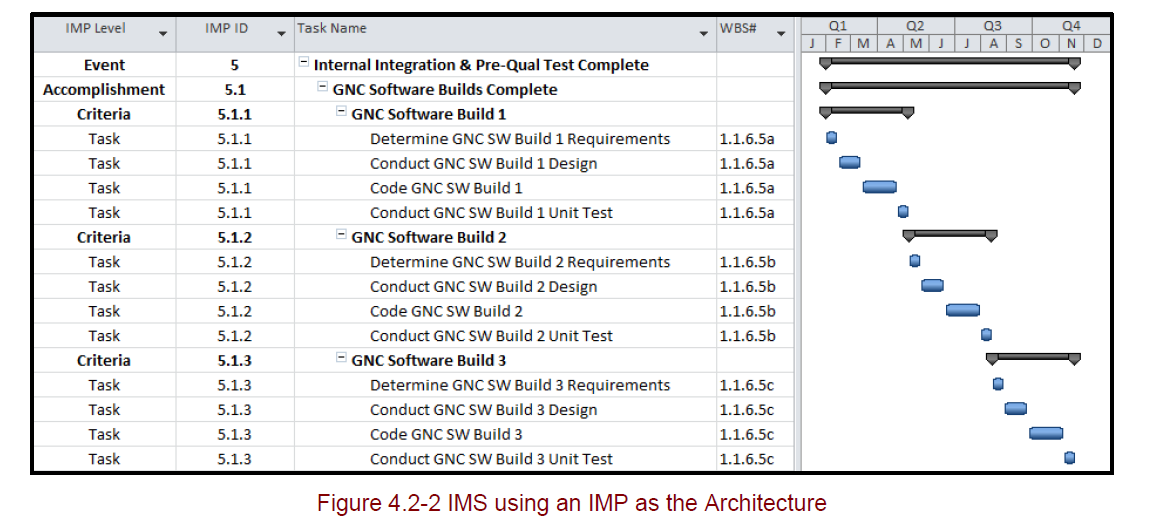
A simple way to internalize this is to recognize that “Design Complete” is not a date—it is the point at which specific, testable criteria have been met.
Where did the IMP come from (and why)?
The Integrated Master Plan originated in U.S. Department of Defense acquisition programs, particularly within Air Force and large aerospace development efforts. It was further shaped by NASA and major contractors working in environments where technical risk, scale, and stakeholder oversight were significant.
These programs exposed a recurring issue: traditional schedules and WBS-based planning approaches did not provide objective measures of progress. Teams could report high percentages of completion while still lacking the evidence required to support key decisions.
The IMP emerged as a response to this problem. By structuring plans around events, accomplishments, and criteria, programs could define progress in terms of verifiable outcomes. Percent complete became less relevant than whether the required conditions had been demonstrated.
Guidance such as the PASEG reflects this perspective by emphasizing that progress is demonstrated through accomplishments and exit criteria, forming the foundation for a credible, logic-driven Integrated Master Schedule (IMS). The IMP was not created as a theoretical construct—it was developed to manage complexity using objective evidence.
IMP vs IMS: Logic vs Time
The relationship between the IMP and the schedule is often misunderstood. The IMP defines the logical progression of outcomes, while the Integrated Master Schedule (IMS) defines the timing and sequencing of the work required to achieve them.
Without an IMP, a schedule is effectively a collection of tasks arranged in time. With an IMP, the schedule becomes a model of how outcomes are achieved.
This distinction aligns closely with guidance from the GAO Schedule Assessment Guide. GAO emphasizes that a credible schedule must demonstrate clear logic, traceability, and objective status measurement. It also stresses the importance of milestones with defined entry and exit criteria and cautions against relying on subjective measures such as percent complete.
In that context, the IMP provides the structure that enables those expectations to be met. GAO guidance focuses on how to evaluate a good schedule; the IMP helps define the conditions that make a schedule credible in the first place. When schedules struggle to meet GAO best practices, the issue is often upstream—unclear logic, weak milestones, and subjective status are frequently symptoms of a missing IMP structure.
Example: Managing the DoD Acquisition Lifecycle
The value of the IMP becomes clearer when viewed against the complexity of the DoD acquisition lifecycle. The DAU “i-Chart” presents this lifecycle as a dense network of phases, milestones, technical reviews, and decision points. Program managers are not simply coordinating tasks; they are managing a series of conditions that must be satisfied to obtain approval at each stage.
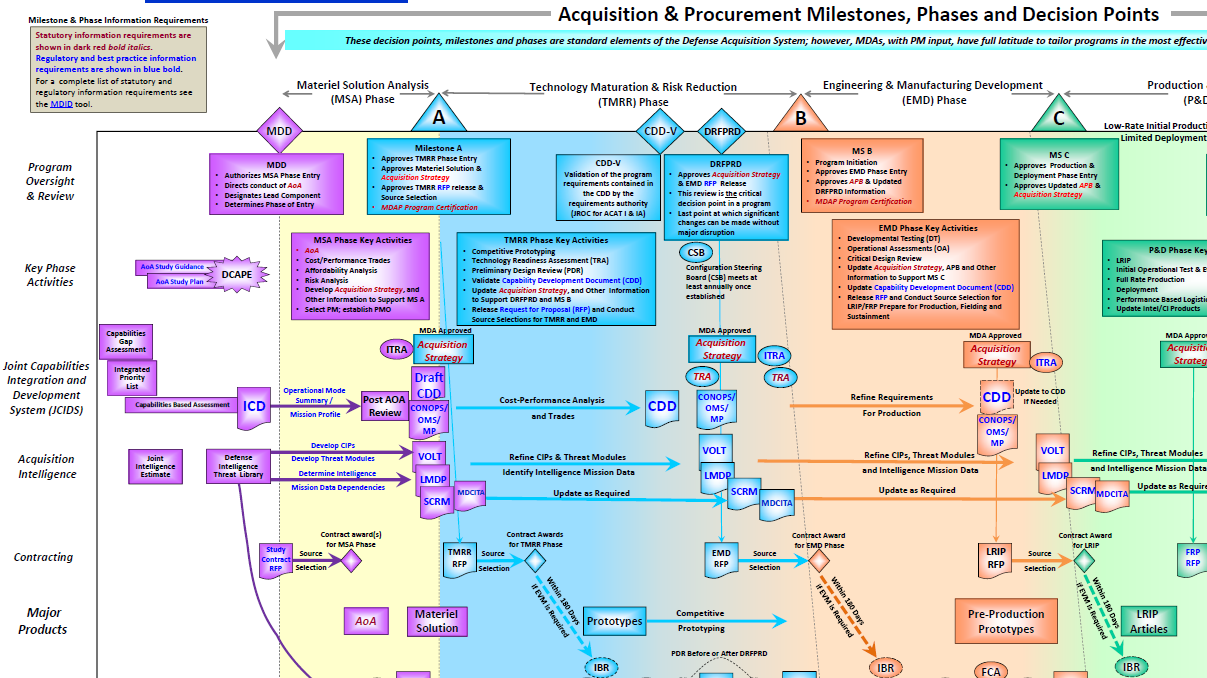
Milestones such as A, B, and C are not merely dates—they are decision gates. Each gate requires a body of evidence, supported by technical reviews such as the System Requirements Review (SRR), Preliminary Design Review (PDR), and Critical Design Review (CDR), along with numerous deliverables defined through CDRLs.
Without a coherent structure, planning in this environment can become difficult to manage. The IMP provides a natural way to organize this complexity.
Within this structure, events align with major milestones, accomplishments align with technical reviews, and criteria align with the deliverables and artifacts required to support those reviews. Each level answers a distinct question: What decision are we trying to reach? What must be demonstrated to get there? What evidence proves it?
The key point is practical rather than theoretical. The acquisition system is complex because of the number of conditions that must be proven, not simply the number of tasks. The IMP provides a structure for demonstrating that those conditions have been met and for aligning work to the evidence required by stakeholders and decision authorities.
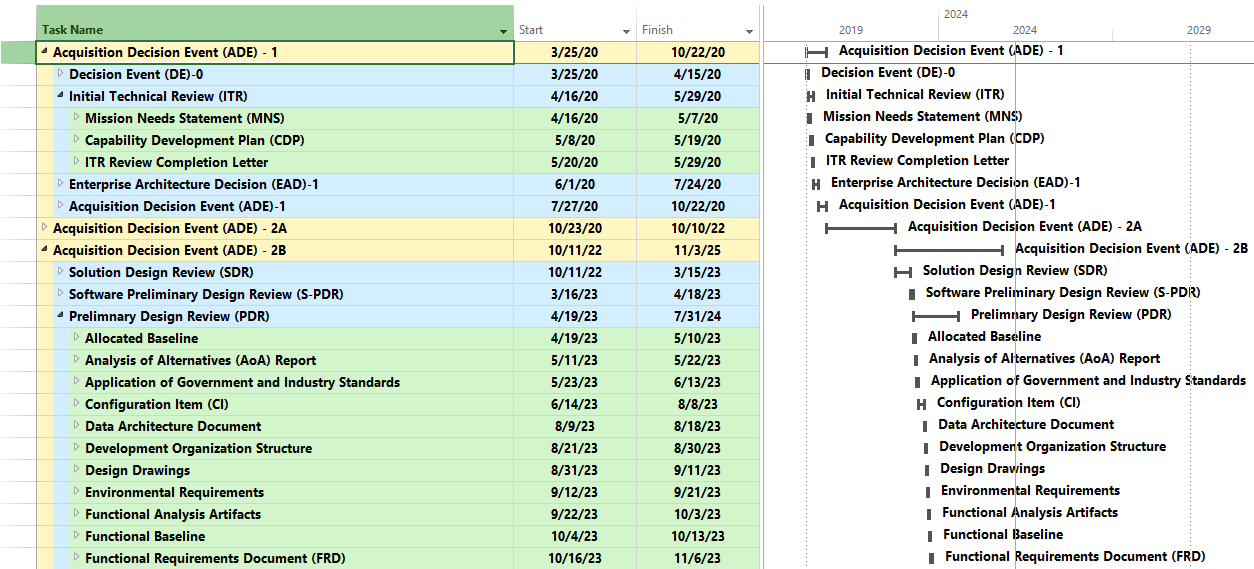
In this context, the schedule does not define the events—it responds to them. The IMP defines the structure that the schedule must support.
Why This Matters for Everyday Projects
The principles behind the IMP are not limited to large defense programs. They address common challenges encountered in many project environments, particularly those involving multiple stakeholders and complex deliverables.
When applied in practice, the IMP provides several tangible benefits:
- It gives schedulers a way to demonstrate to stakeholders that all required conditions for success are being addressed.
- It reduces reliance on vague measures such as percent complete by focusing on verifiable outcomes.
- It improves alignment by establishing a shared understanding of what “done” means at key points.
- It helps prevent rework by clarifying expectations before execution begins.
- It supports more objective and defensible status reporting.
This approach provides immediate confidence that all required bases are covered, that nothing critical has been overlooked, and that the plan aligns with stakeholder expectations. The result is faster and clearer decision-making with less ambiguity.
What a True Integrated Master Plan Looks Like
The IMP provides a disciplined way to structure progress using events, accomplishments, and criteria. By itself, however, it represents only part of the overall planning picture.
A true integrated master plan would combine the IMP with the WBS. The IMP defines what must be proven over time, while the WBS defines what is being built and how it is costed. Together, they address the fundamental questions of what is being produced, how resources are allocated, and how completion is demonstrated.
In that combined view, the name Integrated Master Plan begins to make more sense. Integration is achieved by linking outcome-based planning with scope and cost structures, creating a coherent model that supports both execution and decision-making.
The next article will explore how to integrate the IMP and WBS into a single planning framework, connecting schedule logic, scope, and cost into a true master plan.