Edge-Based Network Scheduling
An edge-based dependency model where non-labor events — deliveries, procurement milestones, external windows — participate as first-class network nodes, not proxy tasks.
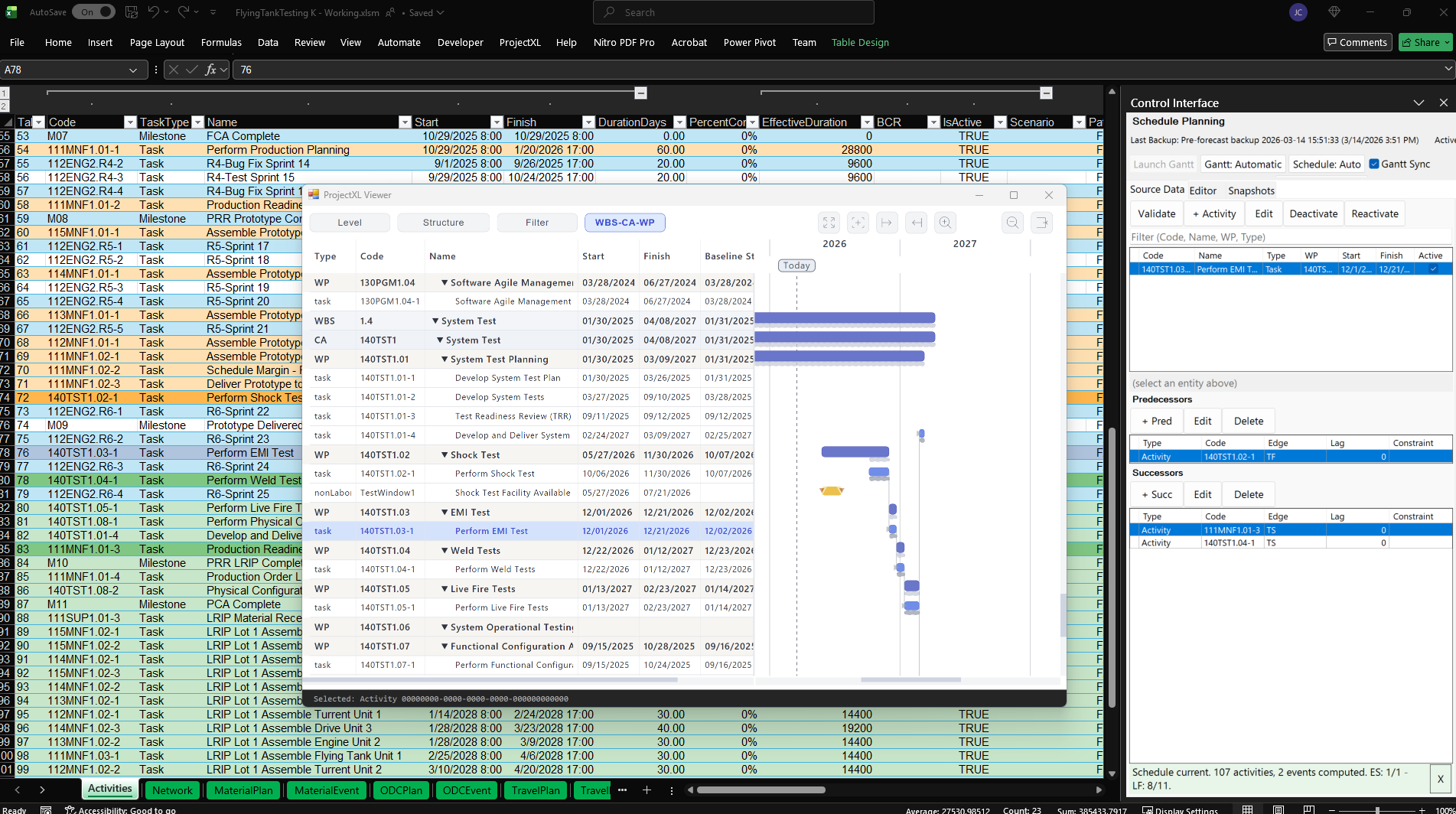
ProjectXL implements a full deterministic scheduling engine inside Excel using an edge-based network model. Unlike Activity-on-Node scheduling — where relationships connect activity boxes — the edge-based model attaches predecessor and successor relationships to the specific start or finish edge of each activity. That distinction enables dependency compositions that are awkward or impossible in traditional tools without workarounds.
Edge-Based Relationships
The engine supports all four standard relationship types: Finish-to-Start (FS), Start-to-Start (SS), Finish-to-Finish (FF), and Start-to-Finish (SF), each with optional positive or negative lag values. Because relationships attach to specific edges rather than activity boxes, Hammock tasks that span governed network subsets work correctly — the hammock spans the exact start and finish edges of its child activities without requiring artificial milestone tasks to anchor it.
Non-Labor Events in the Network
Non-labor events — material deliveries, ERP-sourced procurement milestones, and external system availability windows — participate directly in the schedule network as dependency nodes. A delivery date is not approximated by a proxy task that someone must remember to update. It is a governed event in the network that planners can use as a predecessor or successor, making real-world supply chain dependencies part of the schedule logic rather than a note outside it.
Calendar Integration and Constraint Logic
Every activity is scheduled against a specific calendar, and the engine respects working days, holidays, and custom shift patterns when computing durations and dates. Edges can carry constraints — As Soon As Possible (the default), Start No Earlier Than, or Finish No Later Than — and constraint violations surface in the validation panel rather than being silently absorbed into computed dates.